- 92 302 252 4446
- info@hostingwala.pk
Trusted Website Hosting Agency in Pakistan

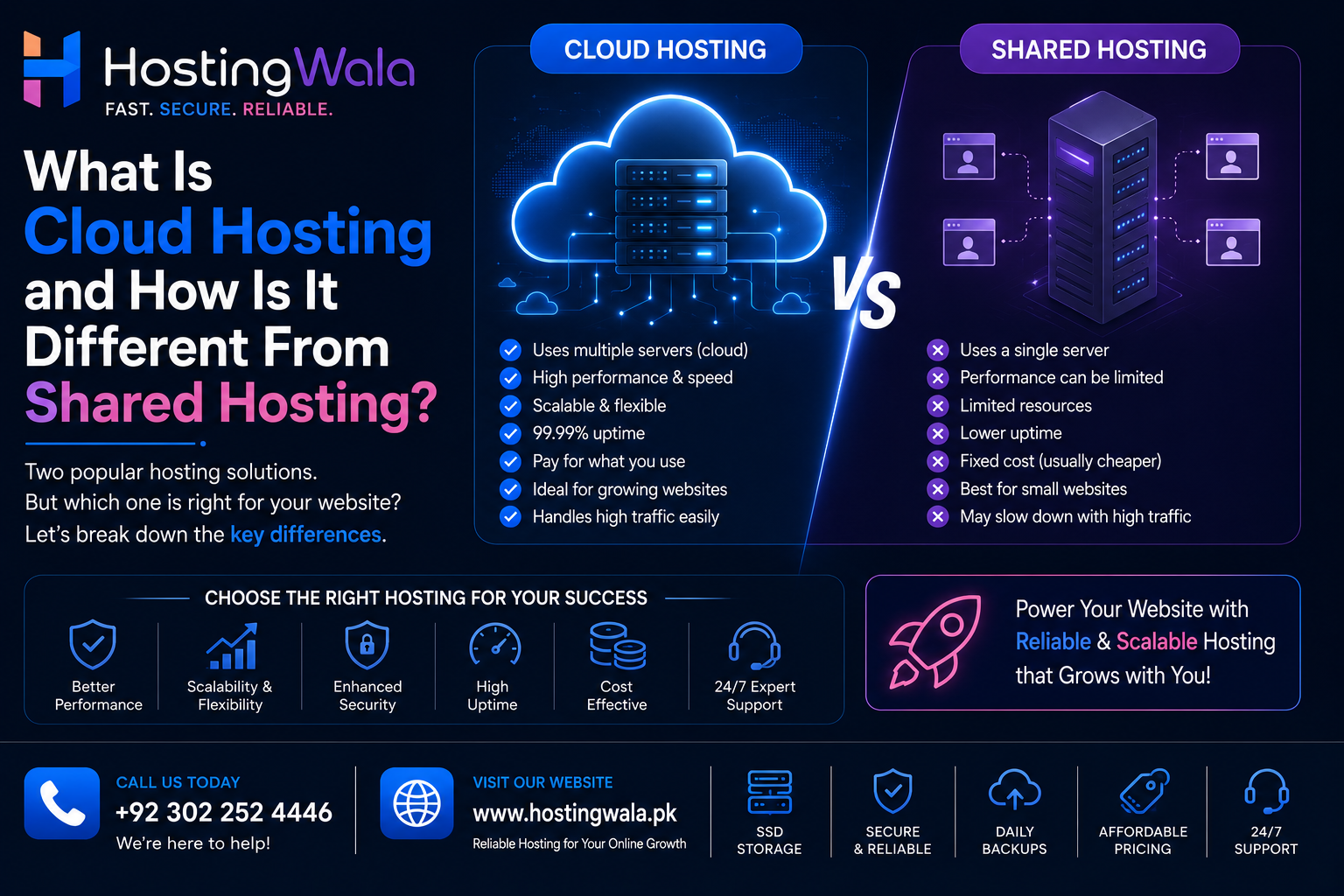
What Is Cloud Hosting and How Is It Different From Shared Hosting?
Cloud Hosting is a form of web hosting that uses resources from a network of connected servers instead of from a single physical server. This configuration can offer better scalability and resource flexibility than traditional shared hosting. Shared hosting is usually cheaper and more appropriate for smaller websites, while cloud hosting can be helpful for websites that require more resources or have variable traffic.
Introduction
The right hosting can directly affect the performance, reliability, and growth potential of a website.
Shared hosting is often a cheap place for smaller sites to start. But as the traffic and resource requirements increase, website owners may start looking at Cloud Hosting.
Knowing the difference between these two options can help you select a hosting plan that fits your website’s real needs.
What Is Cloud Hosting?
Cloud Hosting relies on a network of connected servers to offer hosting resources.
The hosting environment can share loads between different resources instead of relying solely on one physical server.
This structure can give more flexibility if a website needs more resources.
Cloud hosting is often looked at for:
- Expanding Business Web Sites
- E-commerce stores
- Websites with lots of traffic
- Web apps
- Sites with variable resource needs
The precise architecture and benefits will vary depending on the hosting provider.
What is Shared Web Hosting?
Shared hosting puts multiple web sites on the same physical server and its resources.
It’s popular because it’s usually cheap and easy to deal with.
Shared hosting is ideal for:
- small business website
- Personal web pages
- Blog Posts
- new sites
- Web sites with low-to-moderate traffic
However, resources are shared across multiple sites, so the amount of performance available can depend in part on the hosting environment and the provider’s limits on resources.
Cloud Hosting vs Shared Hosting
The main differences can be summarized below:
| Feature | Cloud Hosting | Shared Hosting |
| Infrastructure | Network of connected servers | Shared physical server |
| Scalability | Generally higher | More limited |
| Resources | More flexible | Shared |
| Cost | Usually higher | Usually lower |
| Best For | Growing or demanding websites | Smaller websites |
| Management | Depends on provider | Usually beginner-friendly |
Neither option is automatically better for every website. The right choice depends on your requirements and budget.
Advantages of Cloud Hosting
One of the biggest advantages of Cloud Hosting is flexibility.
Scale-up
As websites grow, they may need additional resources at peak traffic times. Cloud environments can offer more flexibility in scaling resources.
Flexibility of Resources
Cloud hosting can give you access to resources that are better suited to websites with changing workloads.
Dependability
Cloud environments can use more than one server, and so can be more fault-tolerant than a single physical server environment. But real uptime is dependent on the provider’s infrastructure and configuration.
When to Pick Shared Hosting
Shared hosting is a good solution when you are starting out a website and don’t need big resources.
A small company website with a few pages and moderate traffic may not need the extra resources of cloud hosting, for example.
Choosing a hosting solution that is more expensive than necessary can add to costs with no real benefits.
When Should You Opt for Cloud Hosting?
Cloud Hosting is great for growing resource needs or fluctuating website traffic levels.
It might be worth considering if:
- Your site is growing rapidly
- Traffic varies a lot
- Your application requires additional resources
- Your hosting limits are starting to get restrictive
- You need more resource flexibility
Before you upgrade, make sure you know the true cause of any performance issue.
How to Select the Right Hosting
Just because a hosting company uses the word “cloud” doesn’t mean you should pick them.
See also:
- CPU and memory resources.
- Type of storage
- Bandwith
- Server locations
- Possibilities for backup
- Security features
- Assist
- Upgrade Choices
- Limit resources
The name of the hosting may be less important than a properly configured hosting service.
Frequently Asked Questions
What is Cloud Hosting?
Cloud Hosting uses the resources of multiple connected servers to host websites and applications . Many hosting environments offer greater flexibility and scalability.
Cloud Hosting Vs Shared Hosting – Which One Is Better?
Not necessarily for all sites. Shared hosting is a good choice for smaller sites , while cloud hosting is better for sites that need a little more power and scalability.
Does Cloud Hosting cost more?
Cloud hosting is often more expensive than simple shared hosting, but costs vary greatly depending on the provider and plan.
Yes, small businesses can use cloud hosting.
Yes. Cloud hosting can be used by small businesses when they need more resources, flexibility or scalability for their website. But a smaller website might do just fine with shared hosting.
Yes, you can migrate from Shared Hosting to Cloud Hosting.
Many hosting providers offer customers the choice to upgrade to a new hosting environment or move into another one. Exactly how this is done depends on the provider and the hosting platform.
Final thoughts
Cloud Hosting provides a flexible hosting environment that can be beneficial for websites with growing or changing resource requirements. And shared hosting is still a viable and affordable option for many smaller websites.
The best option will depend on your website traffic, resources, technical requirements, budget and expected growth.
Shared hosting could be enough for your little website. If you anticipate your resource requirements increasing, investigating cloud hosting could offer the scalability you need as you expand down the line.